Mint, Mint, and More Mint

Ed is working on the next installment of our Endangered Skills series and probably a rant about law mowers. I thought I would talk about the one thing I planted that will go on and on without me: Mint.

Yes, mint is invasive.

I’m ok with that.

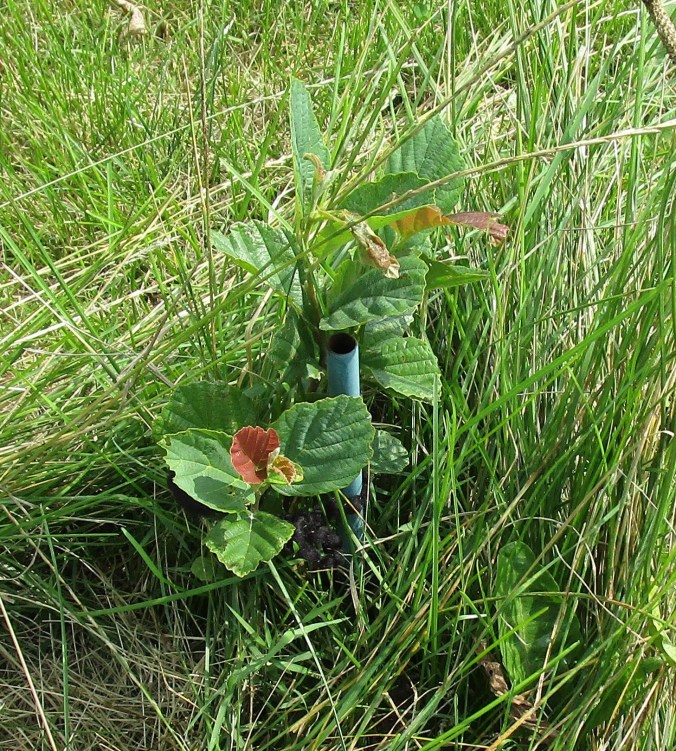
I think I told you a few years ago, that I really wanted to turn the front yard into a garden, not only for the benefits of having a garden, but also because we wouldn’t have to mow it. Well, we have Maple trees, a very small witch hazel sapling, a few day lilies and we have mint….we also have thistles, but I would rather they go somewhere else. I’ve planted other things, especially down near the road hoping they would grow up hill. Not only have they not grown up hill, they haven’t grown at all. I can’t even find where they were planted.

IMG_0021

Little witch hazel

Yes, I got a new camera. It’s an updated version of my old one and lets me use wifi to upload the pictures.

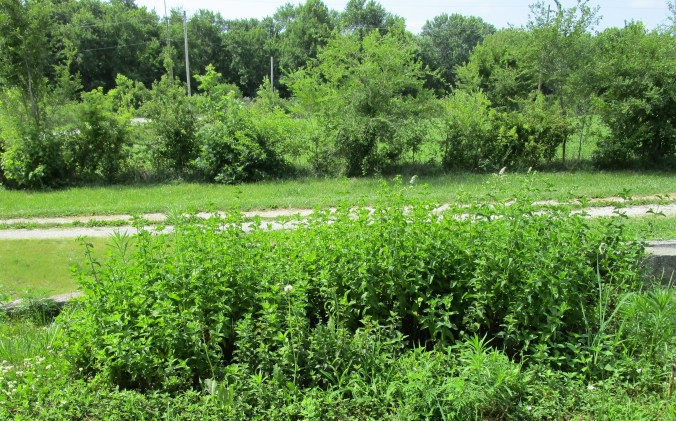
The two or three little mint plants I put out there two years ago, have expanded to about 15 square feet. That’s 15 square feet we don’t have to mow.

img_0018.jpg

The mint bed, with a few weeds in the front. The tallest plants that are just starting to flower are almost waist high for me, so they are about 3 feet tall.

I haven’t even tried to harvest any this year. To be honest, I don’t use much of it. For me, the smell can be overpowering, particularly spearmint. That probably has something to do with family road trips when I was a kid. I had a tendency to get back seat carsickness, and somebody was always passing out Wrigley’s Spearmint gum. The two are irrevocably connected in my mind and so the smell of spearmint can make me nauseous. It’s strange because mint is used to treat nausea.

Peppermint is another matter. Its the smell of candy canes and Starlight Mints. Peppermint essential oil is fantastic for stopping headaches.

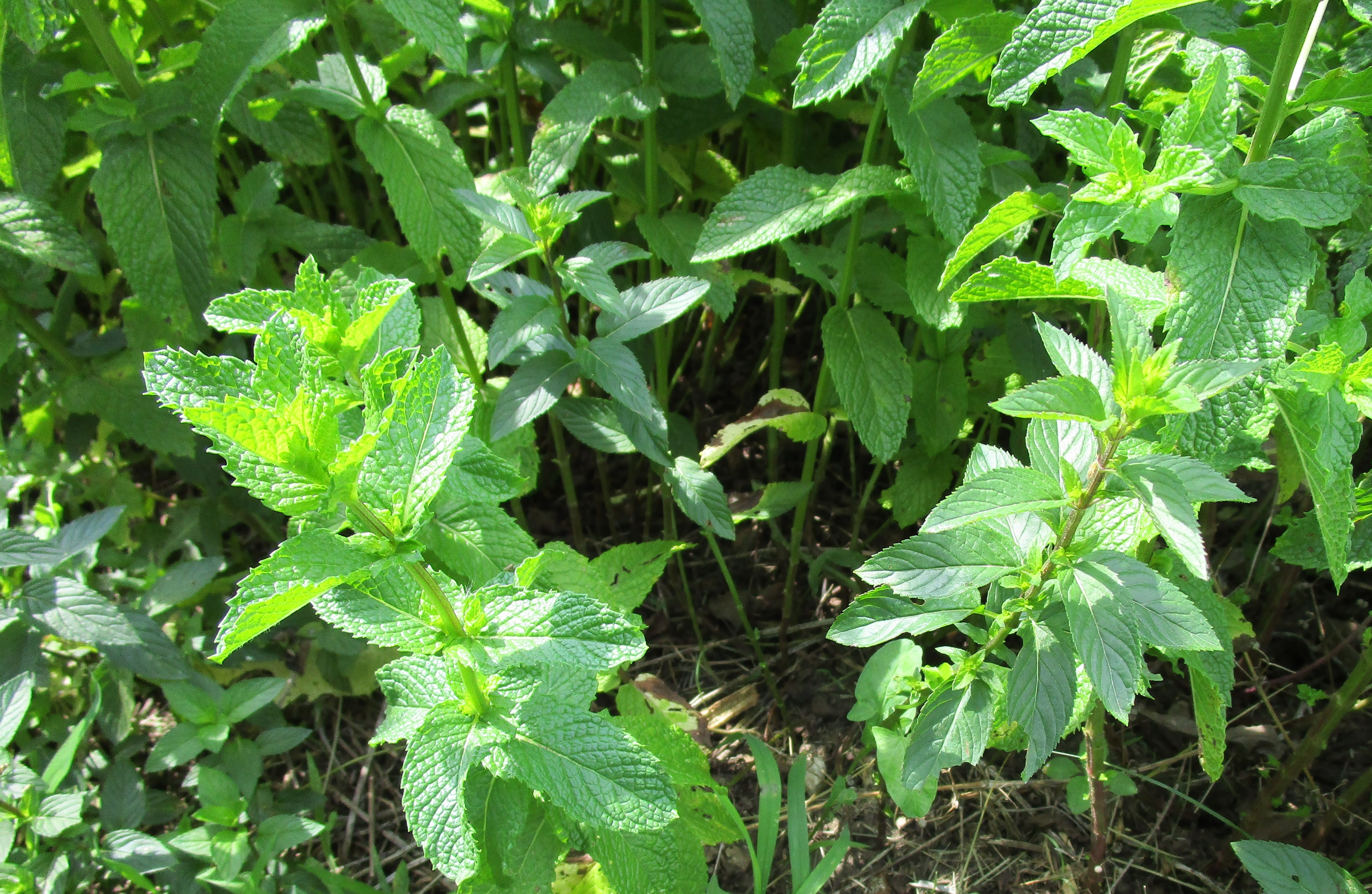
We have both kinds of mint growing and fortunately, they are easy to tell apart. Spearmint leaves have a rough texture and are a light shade of green. Peppermint is slightly darker, and has much smoother leaves. I used to have some chocolate mint too. Yes, it smells just like Thin Mints.

img_0019.jpg

Spearmint on the left and peppermint on the right.

The mint family of plants is huge. I read somewhere there are 3200 varieties. You can learn more about them here. One of my favorite members is lemon balm. I had a pretty good stand of it when we lived in Independence, and planned to bring cuttings with me, but my accident during our move stopped all that. I started some lemon balm seed summer before last, but it didn’t make it. Catnip is also a member of the mint family. Our cats are divided on it. Captain and Bookworm could take it or leave it. Adora likes it, but Marshmellow was the catnip junkie.

There is so much you can do with mint, and there is plenty of information out there in blog land to prove it. This is a good post that links to several other good posts. I may have to try the mint infused honey. I could do one of the salves too. I think I have everything I need. I let you know how it turns out.

Anybody want some mint?

Connie

P.S. If you like our posts, please follow us, and share us on social media.
Thanks!

Endangered Skill #4: Reading the Weather

“I smell rain.”

I don’t know how old I was when I heard my grandma say those words, but I know I was immediately fascinated. It wasn’t raining. To my young eyes, it didn’t look like it was going to rain. What did she mean? I sniffed the air. I smelled something different, something I still can’t describe. I call it “rain”, and it usually means we’re going to get wet.

I probably would have smelled it this week, if I had spent any significant time outside. In two days, we got about five inches of rain.

Weather is important to everyone. These days most of us can get weather information from TV, radio, and the internet. We can watch the radar and get instant information about what is happening right now, and what we might expect next.

That being said, have you ever noticed how often the predictions are off a little? How about dead wrong? Did you ever hear about the lady who called the local weather man to ask him why she was sweeping six inches of “partly cloudy” off her front porch?

Have you ever been some place where it was raining on one side of the street and dry on the other? People on both sides of the street listened to the same weather forecast. One side will say the forecast was right, the other will say it was wrong. The Economist has an interesting post about the subject of weather forecasting accuracy.

So, if our professionals have trouble predicting the weather, what are the rest of us supposed to do? Further more, what did our ancestors do before there were professionals as we know them today?

Well, there are some things, like smelling rain, that seem to be at least as reliable as our local meteorologist. One of the reasons we listed reading the weather as an endangered skill is because it’s one of those things for which we rely so much on technology, we forget to use our own senses. We just need to get our heads out of our cell phones and pay attention.

The first volume of the Foxfire series, simply called “The Foxfire Book”, has a chapter called “Weather Signs”. At first glance, you might think you are reading a bunch of old wives tales, and some of them might be, but not all. Here are a few samples from page 208:

“Forecasting Winter By Animals
It will be a bad winter if:
squirrels begin gathering nuts early (middle or late September)
muskrat houses are built big.
beaver lodges have more logs.
the north side of a beaver dam is more covered with sticks than the south.
squirrels’ tails grow bushier.
fur and hair on animals such as horses, sheep, mules, cows and dogs is thicker than usual.
the fur on the bottom of a rabbits foot is thicker.
cows’ hooves break off earlier.”
And the list goes on for three pages, and includes methods for predicting other types of weather as well.

Chicken Girl’s dad grew up in a logging family in rural Kentucky. Once, when we lived there, I noticed the leaves on some of the trees had turned upside down, showing their undersides. I mentioned it to him, and he said the trees were expecting rain.  I’ve seen it bear out more often than not. You can notice it from a distance, because the underside of leaves are usually a different, more subdued color.

Dad has lived in Georgia since 1970, and he has told me many times, when the weather is coming straight across (meaning out of the west), it won’t be that bad, but if I comes up from the Gulf, (out of the southwest), “we’re going to get it.”

Dad also says to gauge what kind of winter you’re going to have, look at horses and cows. If the winter is going to be a bad one, they will “coat up”. That means their hair will get thick and woolly-looking. Sounds like one of those “signs” from The Foxfire Book, doesn’t it? I’ve actually noticed this looking at livestock while riding down the road, and on our own dogs, particularly Libby.

I’ll bet you’ve heard this before:

“Red sky at night, sailor delight.
Red sky at morning, sailor take warning.”

Dust and water vapor particles in the atmosphere indicate weather conditions. The amount of each also determine the colors we see at sunrise and sunset. For a further explanation of that and some other good information for understanding your local weather patterns, look at this post from How to Provide for Your Family. In it, the author mentions that leaves turn over when the wind is coming from an unusual direction. Could that also be an indicator of rain? I don’t know, but it might be interesting to find out.

The post also mentions that the high humidity/low pressure combination that signifies a cold front, and often precipitation, can produce bodily aches and pains, as well as “antisocial behavior”. Ed and I can both attest to the bodily aches and pains part. As for antisocial behavior, I do know that people seem to get testy when the weather is hot and humid.

Weather has always fascinated me, and I love thunderstorms, but I’ll be honest. My mind just will not grasp the science part of it. I don’t know why, and it’s a little irritating, because I have to keep researching the same information. To quote Chicken Girl, “It just doesn’t stick”.

In other homestead news:

My camera had an accident and is out of commission. If I can’t fix it, which I probably can’t since that is way beyond my skill set, I will have to get another one. In the meanwhile, I got the gorgeous pictures you see in this post from Unsplash.com.

Adora, our injured cat is still recovering. Last Saturday, she came running when she heard me open the back door. A few hours later, she left a dead bird on the front porch. Unfortunately, Wednesday morning, I noticed her left hip looked swollen and it was hot to the touch. I called the vet, and we made another trip to his office. He said it looked like it was an abscess, but it was going to need to come to a head before he could do anything with it. In the meanwhile, he gave us some liquid antibiotic to give her. Either that will make it go away completely, or help bring it to a head so that he can lance it. While we were there, I told them that Chicken Girl though she had found more bites on the back of her head, so they shaved it to get a better look. They confirmed the bite marks, but said they looked ok for now.

With all the rain,we renamed the holes the dogs dug in their pen “Lake Libby”. However, after rain stopped, and the water soaked into the  ground, we discovered most of the holes had filled in. Now they can dig them all out again.

Ed broke down and bought another push mower. He managed to get the front yard mowed before the deluge hit. That’s a start, anyway. We wont talk about the fifteen foot high ragweed that has buried the burn pile and our wheelbarrow.

Connie

Other posts in the Endangered Skills series:

Eight Endangered Skills
Endangered Skill #1: Shoe Repair
Endangered Skill #2: Black Smith
Endangered Skill #3: Small Appliance Repair

Homestead Update

Since Ed updated you on the bees I thought I would  update you on the rest of the homestead.

A couple months ago, I found out I had an umbilical hernia. While we waited for the insurance company to decide if I could have surgery, and then get said surgery scheduled, my doctor gave me one order: No lifting and no straining. Great.

I had visions of spending another summer completely out of commission. I am now happy to report that I had the surgery, it was a success, and I have just been given the go ahead to gradually increase the work I am able to do. Yes, I am obeying the “gradually” rule because I really want to get better.

Since I didn’t know for sure if I would be able work outside this summer, I decided to not have a garden. For the first time in years, I did not buy any seeds or plants. I keep feeling like I’m forgetting something. I am going to use this summer to plan next year’s garden, and work on getting the ground ready.

My camera got knocked off the table with the lens open, and suffered some damage. Sometimes, it works, and sometimes it doesn’t. Chicken Girl took these pictures, and had trouble getting consistent focus.

IMG_2118

Thyme growing inside the tire. If you look closely at the right side of  the picture, you might be able to make out the blue flowers on the Borage plant.

IMG_2126

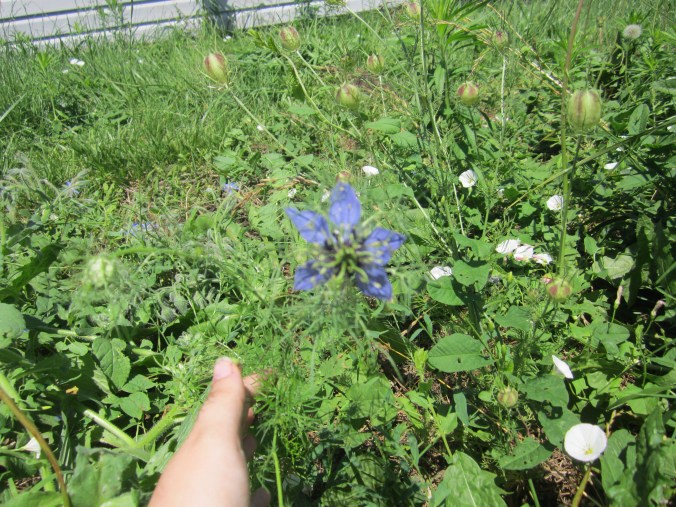
Love in a Mist

IMG_2122

Wild grapes

The thyme survived the winter, and there are some volunteer sunflowers.  Last summer, I planted some Borage and Love in a Mist, but they just decided to come up now. Gotta love those unexpected blessings. I’ve found wild grapes growing in one of the fence rows, and some of the mulberry trees are producing like crazy. The blackberries we planted last year survived for the most part, and a few plants even have some green fruit.

The lawn and weeds have taken off too. Unfortunately, one of our weed eaters, and both lawn mowers are out of commission. Ed will probably want to tell you about that. I did pull a few weeds yesterday, but I got tired quickly, and decided I probably shouldn’t over do it.

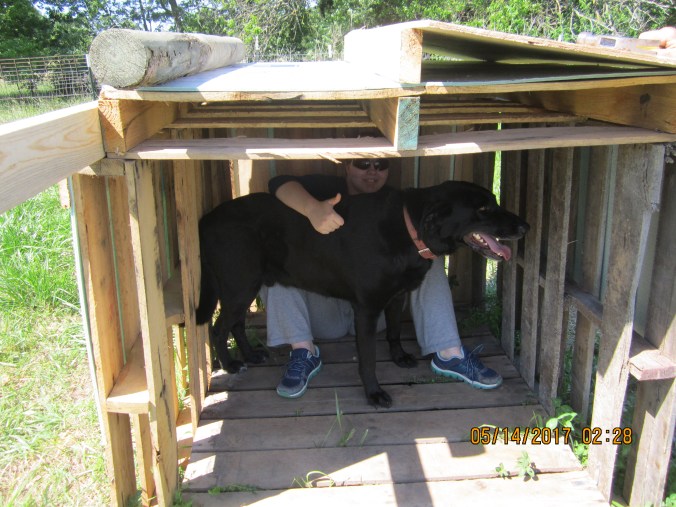
The dogs have finally decided to stay put. Ed is two thirds finished with a new dog house, and they have already moved in. Libby is still digging like crazy, but she has found other places beside the fence. We just have to watch for the sink holes!

IMG_2092

Meeko and Chicken Girl “helping” Ed build the new dog house.

My mom’s best friend decided that Chicken Girl needed a better chicken coop, so she bought one and had it shipped to us. Moony and his girls are living there, and Sunny and company were finally moved from the oldest coop to the new one that we built. Everyone seems happy for now, and the eggs are coming steadily again.

IMG_2079

Moony and the girls in the new coop

Chicken Girl and I finished the school year, and we were both ready. Several months ago, I told you we were getting ready to start dissection in Biology. She did one crayfish, and begged me not to make her do any more. I didn’t, but I adjusted her grade accordingly. Oh, she just had a birthday. She’s seventeen. Time sure flies.

IMG_2015

Chicken Girl and the unfortunate crayfish.

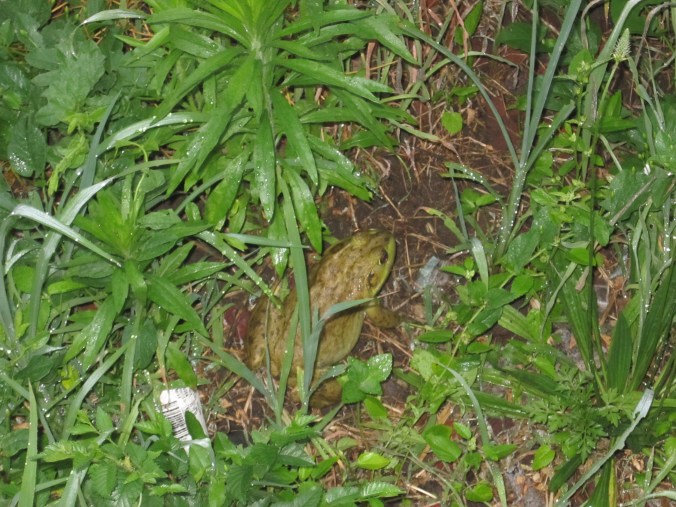
Last week, we had three days in the 90’s and three nights of some intense thunderstorms. We didn’t have any serious damage; just a few limbs down off the big elm tree near the garage. One of those mornings, I stepped out on front porch just to take a quick look around. The weeds all survived. So did this guy.

IMG_2113

Frog just off the front porch.

This morning about 5:00, Ed and I heard a dog barking in our front yard. It wasn’t one of ours. We got up, looked, didn’t see anything, and went back to bed. When we got back up later, I realized two of the cats were outside. Captain came in, but Adora didn’t. We found her this afternoon. She was alive, and she didn’t have any marks we could find, but she was obviously not good. The vet couldn’t find any marks either at first. She has super thick fur. When he finally did find them, there were three or four bite marks and they were on her back end. So, he gave her fluids, antibiotics, steroids, and liquid nutrition. He said to bring her home, keep her warm (her temperature was below normal), and call him in the morning to let him know how she’s doing.  Now she’s covered up in a box in Chicken Girl’s room.

This is a picture I took of her a few days ago: A living bookend. I thought the glowing eyes were funny. IMG_2114

Well, that’s all the news for now.

Connie


BEEginning Again Part 2

IMG_2032

This is a packet of bees.

So, as a complete update, I have my two hives installed. One is doing better than the other but they are both coming along with capped brood and honey present in both hives.

This time I decided, since I had all the equipment, to buy packages of bees rather than nucs. Nucs are basically a mini hive with five frames of honey and brood, bees and an active queen. Packages are simply the bees and the queen. Unlike the nuc, the package’s queen and her new subjects are not formally introduced yet, and this can cause you some problems.  The queen and her retinue come in a separate container.

IMG_2030

A queen container with queen and her attendants.

So we rode over to Chillicothe, Missouri to see Bill and Tammie and pick up our bees. We decided to go in the car and we loaded two packages of bees in the back seat. Would you like to know what will make you a defensive driver? Knowing that, if you break those boxes, you are going to get REALLY busy.

Arriving home we pulled the bees out and looked at them. Here is a look at one of the boxes as seen from above where you take the bees out of.

IMG_2036

Top view of the bee packet.

So here is the trick, I need to get all those bees, the queen and her attendants in a hive without causing major disruption, losing bees (especially the queen) or getting stung.

Step one, the queen: The queen in her little container, is supposed to hang down between the middle frames. There is “queen candy” in one end, which she and her attendants are supposed to eat out, and then the queen should emerge to a grand meeting by her new subjects. Hopefully.

An alternative method is to tape up this hole and hand release the queen about five days after you set up the new hive. I decided, on good advice, to try that. I will tell you the outcome later.

Next, I set up the lower hive bodies and got the hanging feeders ready. We used 4 lbs of sugar to 1 gallon of water. This is the mixture that best stimulates comb making.

IMG_2038

The black thing with two holes in it to the right of the picture is a feeder.

So I set up the two lower hive bodies as shown in the picture above. Please note, almost dead center between the third and fourth frame counting from the left the plastic queen container. They either love her or hate her, hard to say. To that I added another empty hive body. Shaking bees into a hive body is not as easy as it may at first seem and it never sounded that easy to me in the first place. I try to treat the girls like ladies you know.

So I took some advice from Bill George and set them up like this:

IMG_2037

Bee packet upside down over frames.

This allows the bees, who now have food and water available, to crawl out on their on. Thee days later I opened the hive, took out the box and the vast majority of the bees were enjoying their new home.

The queen? I went back a couple days later to free the lady and to put one more set of beetle traps into each hive. When I checked on the queen containers in both cases the bees had already freed the queens. I found the tape lying on the screened hive bottoms when I moved the hive bodies to clean out and put in these traps. Apparently duct tape is not all its cracked up to be, or bees are smarter than we give them credit for.

A tip based on my lessons learned here. When you are only using a small number of frames in a hive box make CERTAIN they are close together. If not you end up with a situation like this:

007

Frames too far apart.

The bees have built comb out attaching the two frames together. I lost some brood because of this and I am jealous of my baby bees.

So I checked them again yesterday and the bees are still great. As I said, one hive is behind some but is still doing well. I enjoy fooling with bees and taking care of them, but that isn’t all I have been doing.

New dog runs and new chicken coops have been happening. I will talk about them later.

Endangered Skill #3: Small Appliance Repair

My dad tells stories about his older brother taking apart toasters, blenders, etc, putting them back together and having them work better, even with a few “leftover” parts. I’m not sure if that’s completely accurate, but I do know that my uncle was really good at fixing things. My dad isn’t too shabby at it either. He’s good at making what he needs out of what he has too, but that’s another blog post.

As a kid and young adult, I remember visiting repair shops where toasters, blenders, and other small appliances were repaired. Sometimes those places fixed TV’s and VCR’s too. I haven’t seen a place like that in a long time. I did an internet search to see if any of those places still exist. A few do, like this one that, at least for awhile, had a blog too.

I found one repair shop that seems to deal with large appliances, but had advice for small appliance repair. They said “Most small appliance repairs are simple so many people generally try and fix them instead of calling a repair person”. You can read the rest of that article here.

I don’t know that most people really do try and fix it themselves. I think they throw it away and buy a new one, because that’s how most of us do things now. That’s what I did for a long time. Sometimes I still do it. Sometimes things aren’t designed to be fixed either, but that’s another blog post too.

My next stop was YouTube. I’ve been part of at least two discussions in the last few weeks where someone said, “You can learn how to do anything on Youtube!” I don’t know if that’s true, but I know that Ed and I both have learned how to do things by using YouTube videos.  I use it as a home school supplement too. I will offer one little piece of advice about that, however. You might want to look at a few different videos, because the one you start with may leave out an important step, (or loosen bolts/screws ahead of time) and not tell you.

Anyway, I searched YouTube for “small appliance repair” and found some great tutorials. I really liked Adam DIY, and watched several of his videos.

I tried to insert his “how to repair a broken toaster” video here, but it keeps showing up as “how to clean a table saw blade”.   I tried another video on his channel, and it did the same.  The table saw video is the first one on the list, and for some reason that is the only one that will play embedded here. Here is the link to the toaster video.

This video from comeinhandynow, is good too, but it’s dealing with a more complicated problem.

https://www.youtube.com/watch?v=kXn1lTYCtGshttps://www.youtube.com/watch?v=kXn1lTYCtGs

Have you ever tried to fix a small appliance?

How did it turn out? Let us know in the comments below.

Connie

BEEginning Again Part 2

The last time I wrote about re-starting my bee venture, I told you I had lost two hives late last year to Small Hive Beetles. This year I bought two packets, and they have been delivered, but first I want to talk about my clean-up for Hive Beetles.

Overall it is pretty simple. You want to kill the beetles and the larva, and you want to clean out any slime or residue from the infestation. As my friend Tammie George at Crooked Hill Bee Keeping says it, “Bees are better housekeepers than we are.” Mainly you just need to get the ugly stuff left by the beetles out, and let the bees do the rest.

Killing the beetles and making certain they are gone is another matter. Small Hive Beetles can live as long as six months. So I did some exploring and asked some questions of bee friends and got the same idea. Freeze the hive boxes, the frames and the foundations. I left each hive box in the freezer for a month.

IMG_2024

This is what we were working with, I had frozen the hive boxes and set them aside until this day.

Then comes the cleaning. I used a wire brush and two different scrapers to get the majority of all the old comb, and beetle residue, off the hive boxes and the frames. After that, I washed them in hot vinegar water. There are some who use bleach water, but I am leery of non-organic solutions.

IMG_2025

As I said, it is a mess.

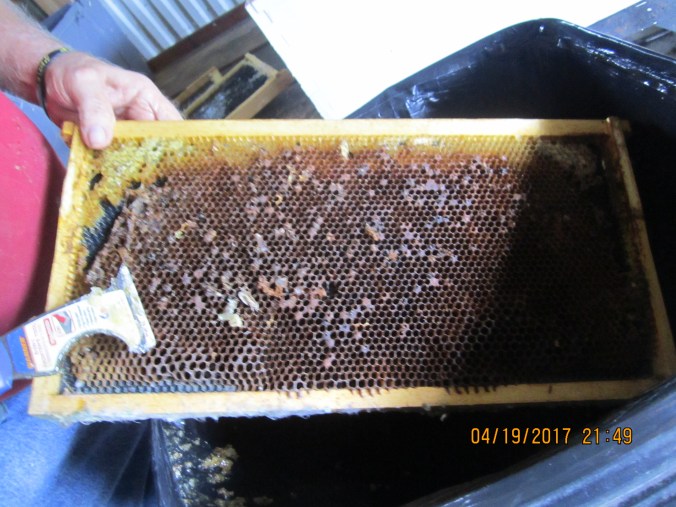
IMG_2023

This view is of a brood frame where the Queen laid eggs. This is what the beetles attack. Honey frames are easily cleaned out and they are clean and yellow. Brood is darker comb and it does not want to come off. Add in the smell of the beetles and it is not pretty.

After I finished I let them dry outside in the sun. I was very happy to see some of the girls (not my bees; they were not here yet), hanging around the old frames, pulling off comb and digging out pollen I had missed.

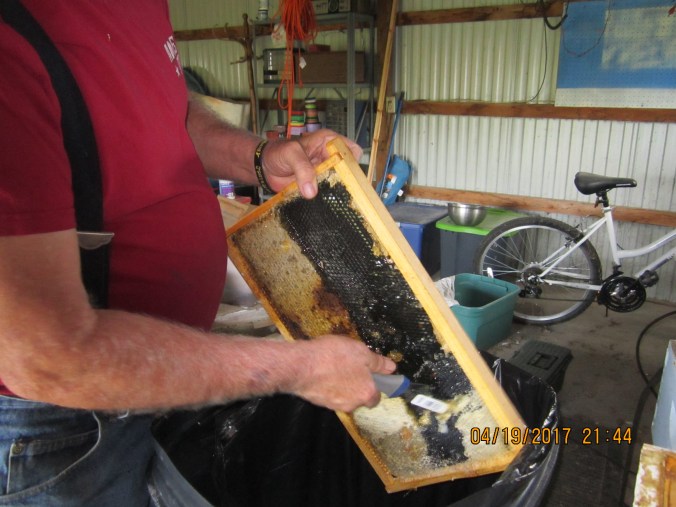
IMG_2021

It is a sticky job, but someone has to do it.

A word about prevention before I close. My mistake was not thinking the beetles would get to me because I interrupted their life cycle. There was no dirt under my hives for the larva to get into because the hives were sat on concrete. I did not take elementary precautions such as simple cheap beetle traps. Now both of my hives have beetle traps in them, and the ground and concrete around the table where my hives sit is salted with diatomaceous earth.  The tuition at the College of Hard Knocks is expensive to our pocket books, our egos and several thousand bees who I let down. I will make more mistakes but not that one ever again.

The following chart came from my first link at the top of this post which links to an article from the University of Arkansas extension service. I would suggest you look at he whole article, it is very informative.

SHB_life_cycle_JZ_UAEX_2011_600px_0

Being me, I let some of it wait longer than I should. However, I got it done in time to move the girls and the Big Girl into their new homes. In the next post I will introduce you.

Endangered Skill #2: Black Smith

I don’t know about you, but when I think about a blacksmith, I see a sweat soaked, soot covered man wielding a hammer. I think of him as someone from the past, as most of us probably do.  My research brought some nice surprises. Blacksmithing is alive and well! The knowledge is still out there, if you want to get it.

So, what exactly is a blacksmith?

According to the American Heritage dictionary, a blacksmith is:

1. One that forges and shapes iron with an anvil and hammer.
2. One that makes, repairs, and fits horseshoes.

Foxfire 5 has an entire section on Iron Making and Black Smithing. It includes drawings and pictures of furnaces, as well as explanations of the difference between wrought iron, pig iron, and steel. Of course, in true Foxfire style, there are the interviews with “old timers” who have inside information on the relevant subject.

“A blacksmith forges objects of metal typically wrought iron or steel. To forge metal is to shape it, by heating then hammering, or pressing it into the desired form.” Foxfire 5, pg 112

“At that time the blacksmith played a vital role in his community and was generally accorded his respect. There is hardly a facet of life his work did not touch upon; indeed without his skills , the prevailing life-style would have been extremely primitive. Most of the items a blacksmith made and repaired were either tools or other work related items, such as harness fittings and ox yokes. In a culture where everyone, even children had to work just to get by, it’s not hard to understand how important the blacksmith was.” Foxfire 5, pg 108.

The book goes into great detail about what a blacksmith does, the tools he uses, and the importance of proper care of tools and equipment.

“On the subject of tools, Leo Tippett said, ‘My father took good care of his tools. He never threw them down in the dirt, or on a rock. They’s scarce. My daddy’d give me a going over if I throwed a tool down in the dirt or rock. And I’m glad he did. You have to respect tools. Good sharp tools are the name of the game’” Foxfire 5, pg. 112

That comment, in itself, says a lot about how attitudes have changed.

Don’t know about Foxfire books? Ed wrote about them here.  It took us awhile, but we finally got the full set.

The blacksmith was important to a community because he made much needed tools and equipment. Today, much of what he did is manufactured in factories and shipped to stores where we buy it. One video I watched said the local smithy has been replaced by Lowe’s and Home Depot.

A partial list of things the blacksmith made is also listed in Foxfire five on pages129-131. Included are the things we normally think of, like horseshoes and axes, but we also find knitting needles, shoe buttons, nails and screws.

According to Simon Grant Jones, the passing of the time when horses were commonly used for work and travel spelled the end of the “traditional country smithy”. Simon is a practicing blacksmith, so take some time to explore his site. Another interesting historical fact he mentions is that often, at the end of the day, embers from the smithy were taken to the bread ovens to bake bread. Talk about members of a community working together!

Once again, I went to YouTube to see what I could find about Blacksmithing. I found a lot! The best one though, was this treasure.  Love that he had kids learning in the shop, not to mention the techie.

If you decide to try and learn yourself, let us know how it goes.

Connie

Good Fences Make Good Doggies

The bees will be here on 21 April, so there will be another post concerning cleaning and setting up my hives shortly. However, another matter has taken precedent and I had to attend to it before I ended up pulling what little hair I still have out. (See the post Don’t Fence Me In).

One of the things I try to do in this blog, is save you the time, money, aggravation and extra work I put in to my ventures, before I succeed. As long as I fall on my face in the direction of the finish line, I do not consider it a failure; just another payment on the tuition at the University of Hard Knocks.
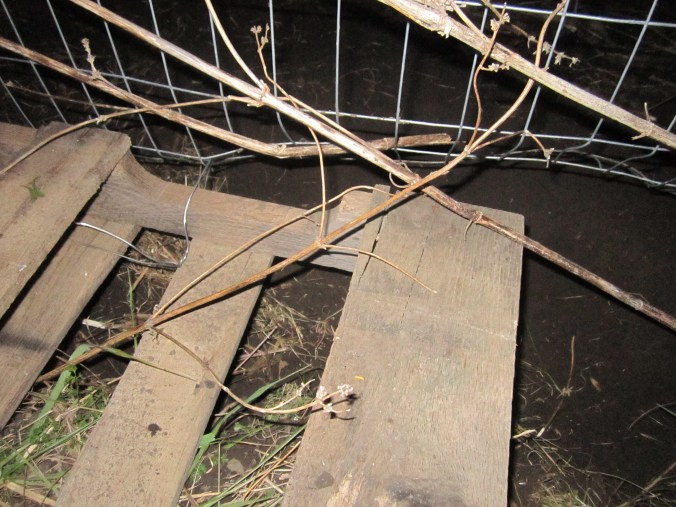
img_1845

This is what playing catch up with a digging dog looks like.

Let’s talk about dog pens for a second. Two years, ago I built one. It seemed simple enough. Just fence in a piece of land, put the big ugly dog house in it, and insert the big ugly dogs. No problem right? Yeah…. sure you’re right.

The first question is, how much is enough land for a dog? I really cannot say. I have sicced Google on the problem, but have not found a satisfactory answer. First time out of the gate, I enclosed about 100 by 80 feet. Yes, that is 8000 square feet. Yes, I am a fool, thank you for noticing.

Shortly I realized that the north fence; the oldest line of fence I incorporated into my new lot, was totally inadequate. For a number of months, I tried to patch it with little success. I used electricity but that too, was inadequate.

Finally, I decided to back off approximately 60 feet, and put a whole new fence on the north side. Now we are down to about 4000 square feet. A little more reasonable. BUT, and there is always a but, Libby, the non-climber, took a special interest in that new 100 linear feet of fence. After the recent winter, the ground was particularly soft. Libby had a field day and once Meeko figured out what she was doing, the gimpy former climber became a pretty fair tunneler.

IMG_1440

Sixty feet less and a brand new fence.


IMG_1432

The first shots in the war for the North Fence

We were off to the races, but when you are patching as they go, you are always behind the power curve. My next attempt was to place pallets around the bottom of the fence; wired in, and nailed together where appropriate. Understand, I am still playing catch-up. While the tunneling duo have a preference for one linear 100 feet of fence along the north side, they have branched out, and it is impossible to predict where they will strike next.
What is wrong with my pallet answer? To start with, the dogs quickly out paced the local Co Op’s ability to supply me with pallets. Second, we are looking at 280 or so linear feet of fence. The average pallet is 44 inches long. That means I will need in the neighborhood of 70 more pallets. That would be a cost of $245.00. Shotgun shells are much cheaper.

img_1901

The first attempt at the pallet answer, for what it cost to do this all the way around I could have bought a better dog.

Then Meeko got out, killed a chicken, and wounded another. Enough. But what to do? I was really considering Turkey Shot. In desperation, we tied the dogs out by the barn and let them sleep in a concrete floored feed room. It was a really bad answer, but only lasted about two weeks.
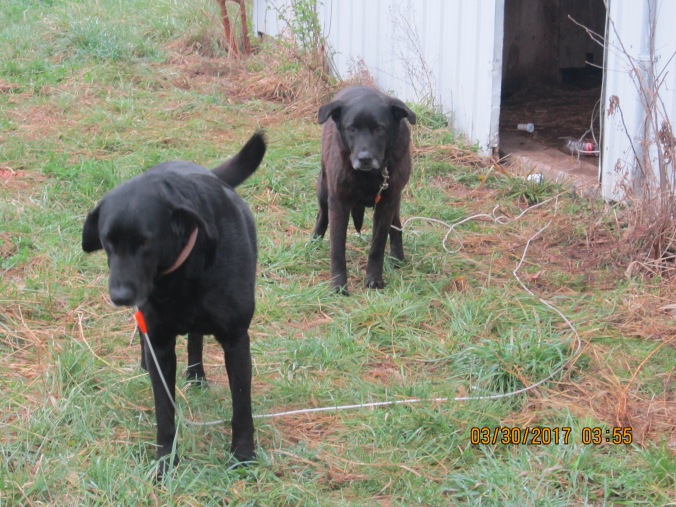
IMG_1971

Tied out dogs them and I both hate it.

Then my lovely wife intervened. She took me out to the dog lot one day, and pointed out one obvious change. Change made: the dog lot is now 40 X 50 feet for two dogs. That would be 2000 square feet. Three or four people have been living in less square footage in our house.

What did this do for my fencing project? First, it reduced the linear footage of the fence by another hundred feet; now it was 180 linear feet. A hard and fast rule is that every foot you can reduce that fence, is one foot they cannot dig out of. Second, it gave me a vast amount of fencing and posts to work with when I reset the fence.

IMG_2005

The infamous north fence. Note the fencing on the ground. Yes, it does appear to be working. No I do not need to lose weight, that is where I carry my lunch. Several of them.

IMG_1991

Kat helping me line up a pole.

IMG_1992

Me driving a pole with a 6 lb pole hammer. Possibly the greatest invention since fire.

Next, I ran fence wire on the ground ,along the line of the fence, sank steel post every five or so (got a bunch of those too),and strung the fence with the able assistance of Kat, the Chicken Girl. Once I had the fence up, Kat wired the fence on the ground and the standing fence together. I added two short poles on the outside which Kat also wired in. These were to make it difficult for the dogs to push out on the fence. Anyway, as I have mentioned, I have a bunch of poles, short and long.
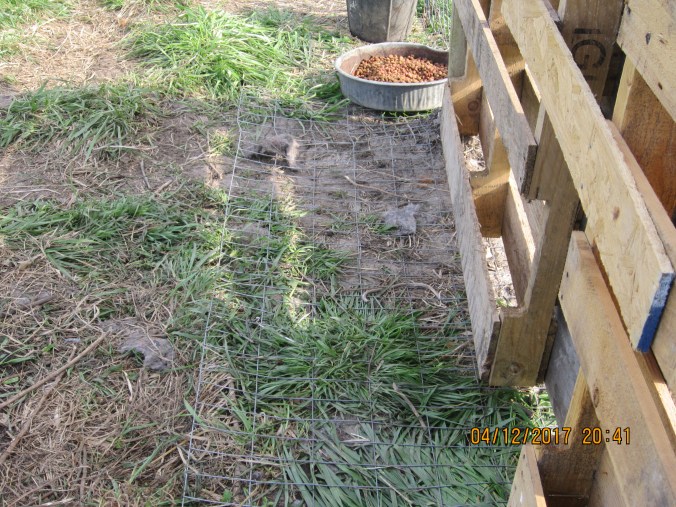
IMG_2009

The inside of the gate. Note the wire, even Libby cannot dig through that.

Then I pulled out the much abused and busted northern line completely. I laid wire down in the same way I had on the eastern side, added some poles, and put a sixteen foot cattle panel at the north-west corner which Libby seemed to take particular joy in attacking. Let her try to chew through that. After that, we fenced the rest. Everyone was helping there, and the dogs, chained in front of the barn, were watching; wishing we would hurry up and finish.

The western and the southern lines were the most stable. Along the western line, I placed all the pallets I still had. On the southern line, I stretched wire on the inside and the ladies wired it in while I was putting together the gate, and mumbling under my breath. It was getting late, but I wanted them in the new yard.

We hung the gate, and brought over the dogs, who were overjoyed about being able to run in their new home. Libby, of course, was checking the fence line carefully.

What can I tell you that you that will save you trouble?

1. Make a reasonable dog run. One lady, who had multiple dogs, said her 60′ X 40′ foot backyard was fine for three very large dogs.

2. If they are dogs, they can dig. Sometimes they dig just for fun. So find some way to build a no dig zone around the inside of your fence at least two feet wide. Wire fence works well; chicken wire not so well. Also, and this is my next project with the dogs, build them some stuff to play on and with.

3. Give your dog plenty of credit for creativity. When you think you have it sealed, think again.

All during the re-fencing project, there was a place where the fence had been bent and broken about 10 inches wide along the bottom. A number of times I said to Connie, “We need to patch that and slap a pole in there. In the hurry to get the Dweeble Twins off the chain (I hate chaining a dog), we neglected this less than a linear foot of fence. I went out the next morning, and they were gone out of that one little hole.

It is sealed now, and my ego is healing.

Thank You

Ed
New Hens and Other Updates

Ed is feeling better and working to rebuild the dog pen. He hoped to finish today, but the weather has not cooperated. Cold and wet is not a good environment for someone barely over an upper respiratory infection, so he spent yesterday working inside. He worked some this morning, but then went to bed, because he has to work tonight. When we finish new pen, we’ll show you what we did.

Last week, I had the opportunity to purchase six grown Rhode Island Red hens from an acquaintance who had more than she needed. When the hens were delivered last weekend, we learned they hadn’t been handled much. Chicken Girl was going to have her job cut out for her.

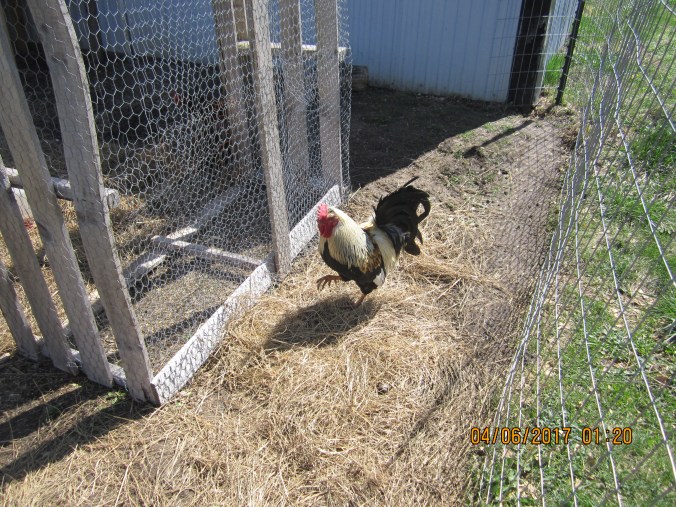
When we first got them, we dumped them in the chicken tractor…literally. They came in a dog crate and the old owners upended the crate under the tractor, while we blocked the sides to prevent escapes. The funniest thing was that within five minutes of getting them in the tractor, Moony Rooster escaped his pen and came running to investigate the new girls.

IMG_1995

Moony Rooster

That evening, we decided we needed to put them in the big coop with the other chickens, because the tractor doesn’t have much in the way of shelter. That was an experience for Katherine. First, raising the tractor enough to grab a chicken that didn’t want to be grabbed. Then trying to hang onto it long enough to get it into the pen. Once she got them all in the pen, then she had to get them into the coop. Still, once she gets hold of them, they calm down quickly. She only got scratched once, and she considered that a win. Every day, it seems that they are easier for her to handle.

IMG_2000

Sunny Rooster and three of the new hens

IMG_1997

Katherine says this is Voca Hen. I’ll have to take her word for it.

The six new girls and the two old ones are having to work out their differences of course, but that was expected. Like she always has, Tundra Hen escapes several times a day. Then Moony Rooster follows her. Day before yesterday, during one of the many daily escapes, Katherine had a moment of panic when she realized Tundra was inside the dog pen. Then she remembered the dogs weren’t there. Later however, when when Ed was moving the dog house, an egg rolled out. Then I noticed the second egg inside the house. I guess Tundra was feeling a little crowded with her new coop mates. Coop improvements will be coming soon.

IMG_1982

See the egg?

IMG_1981

Close up


Have a great weekend,

Connie

One of Those Weeks

Well, maybe, one of those months.

Since Ed and I both write posts for this blog, we trade off weekly posting; last week my post, this week his. The idea is that we both then have two weeks to work on writing a post worth reading…Yes, I know, we don’t always get there.

This is technically Ed’s week. However, Ed has been sick for the last two weeks. What started out as a sinus and ear infection has moved to his chest. He went to the doctor for the second time yesterday, and she started him on a new round of antibiotics and a prescription cough medicine. He really hasn’t felt well, and to be honest, I don’t know if he realizes it’s his “turn”. I’m not going to put any more pressure on him than he has already put on himself. He missed two days work that first week. He made one day up, and has been working ever since, except for his normal days off.

Several weeks ago, he wrote about our constant battle to keep our dogs contained. Pallets around the fence perimeter seemed to be the solution…when we could get pallets. Unfortunately, the supply dried up, and we were back to using whatever we could find. At least twice a day, one of us would walk the fence, looking for evidence of new digging. Once or twice, we found some and were able to block the hole. I would love to go buy everything we need, and just fix the stupid fence, but we don’t have that kind of money, so we do damage control. At least Meeko quit climbing right?

Wrong!

A few days after Ed went back to work, the dogs got out, and I couldn’t find the hole. Using flashlights, Katherine and I walked the whole fence, and could not find where they escaped. I was doing some things in the house that made bringing them in for the night extremely inconvenient. In frustration, I decided to shut them in one of the rooms in the barn that had a cement floor and locking door. Katherine and I carried blankets, food and water out to the barn, and locked them in for the night.

The next day, Ed and I both looked for the escape route, but couldn’t find it. I still can’t believe that Libby climbed the fence, but I don’t have any other explanation for her escape. To see if we could catch them, Ed put out the game camera for a few days. The only thing we saw was chickens, three of our chickens have found out how to get out their pen, and have decided to free range themselves. The interesting thing was that the dogs really didn’t seem interested. Four days later, we found out how wrong we were.

SUNP0022

 From the game camera: chickens outside the dog pen. If Libby sees them, she’s not interested. 

Last Friday, we finally got good, gully washing, basement flooding, rain. We needed it. It’s been a dry winter. That day, our three free range wanna be’s flew out of their pen. I saw them and told Katherine. She can round them up faster than I can, so she went out to get them. A few seconds after she went out the door, I heard a noise that I cannot describe. I went to investigate, and met Katherine and Meeko at the back door.

“Put him in the house! He got Hoppy! Hoppy ran off!” Katherine was already running off to find the rooster when I grabbed Meeko, pulled him inside, went outside myself and shut the door behind me. (Ed was sleeping). My first thought was of Libby, but she was still in the pen.

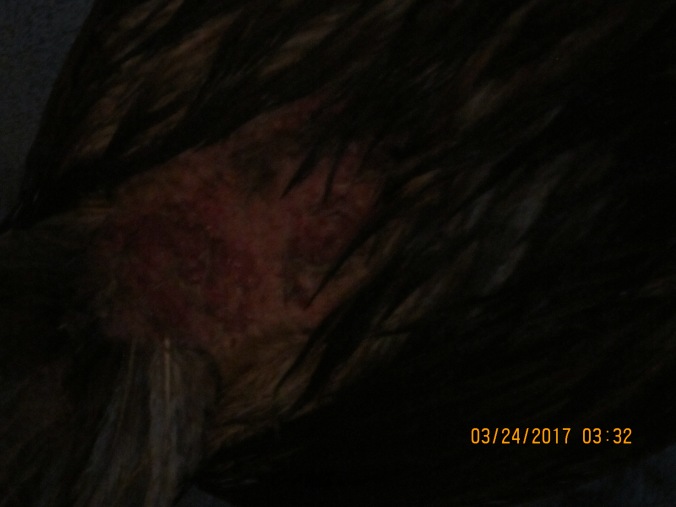
Katherine and I found Hoppy hiding in the weeds. At first glance, he looked like he had been plucked. All the feathers were gone from between his shoulder blades and from his back, near his tail feathers. Later I would change the impression from “plucked” to “skinned”.

IMG_1957

Hoppy’s back near his tail feathers.

I rounded up the other chickens, and then went to get Meeko put back in the pen. Ed was awake and I quickly explained what happened. Once Meeko was out of the house, Kat brought Hoppy in and we cleaned and treated his wounds. Then we put him in a crate in Katherine’s room.

Did I mention, it was pouring? Yeah, we were all soaked.

Ed and I restarted the discussion we’ve had too many times: How do we keep the dogs in? Ed went to the barn and came back with two cables with hooks on them. His thought was that we’re going to have to tie them up, we just weren’t sure how to do it.

A little while later, one of us, I don’t remember which, saw Libby outside the fence. I went out first while Ed went to get his shoes. By the time I got outside, Libby had bolted. I saw both dogs on the far side of my neighbor’s house, and called to them. Then I saw the other dog. Meeko ran toward it, and then both dogs ran back toward me, with the new dog coming quickly behind. I got Meeko, and gave him to Katherine. I turned to see Libby head back toward the other dog. In the meanwhile, our neighbor’s son came calling the other dog. I called Libby again, and for the first time in her life, she came to me, and I was able to get hold of her.

The man was apologizing for his dog, and I was apologizing for ours, and somehow, Katherine lost her grip on Meeko. Fortunately, Ed was out by then and was able to get him before our neighbor’s son was in the middle of a dog fight. Fuming, Ed headed toward the barn with Meeko. I sent Katherine to the house for a leash, and when she brought it, I used it to take Libby to the barn as well.

Ed had to go to work, so Katherine and I would have to deal with letting the dogs out to do their business. That would be ok for the night, but what about tomorrow? Then I remembered the cables. I attached them to a stall door, and then was able to use them to let the dogs out.

Hoppy died the next day. We were even more determined. We know that we need to do something about the chickens too, but we feel that the dogs are the bigger issue. Even if we could protect our chickens, some of our neighbors have chickens too.

The original plan was to keep the dogs tethered out for a few days  while Ed and I did some serious refurbishing of the pen. We decided we would start over. We would clear the fence rows, and combine everything that we have to dig and climb-proof the pen. We would even get out the electric fence box and see if we could figure out why it won’t work. We would start on Ed’s next day off. The dogs would only have to spend a few nights in the barn, and a few days tethered.

The Ed got sicker. His chest is so congested that he gets winded easily and has been sleeping a lot. I can’t help but feel that if I had been a little more on the ball with learning about natural remedies, he might have been able to head some of this off. I’m not real crazy about his having to take a second round of antibiotics, and neither is he, but that is where we are.  I’ve been dealing with some health issues myself, and that doesn’t help either.

Ed says he is feeling a little better today, but he has to work tonight, so we’ll see how he is in the morning. Prayers are always appreciated.

As for the dogs, they are just going to have to deal with being tied out for a little while longer.

IMG_1971

Unhappy Dogs

Connie